
Grinding, squealing, or a pedal that pulses under your foot? The real questions are what the fix involves and whether it can be done where your car is parked.

Most pad and rotor work can. Our mobile brake repair comes to you: we do the brake job at home, in your driveway, garage, or office lot: wheels off, a real inspection, a clear quote, and the repair, usually in the same visit. Here's what that looks like, step by step.

  • Brake pads
  • Rotors
  • Calipers & slide pins
  • Brake fluid
Call 720-507-7918

What Your Brakes Are Telling You

Different noises point to different parts. This is where we start:

  • High-pitched squeal when braking: often the small metal wear indicator on the pad touching the rotor.
  • Grinding or growling: the friction material may be gone and the steel backing plate is rubbing the rotor. Every stop now damages the rotor, so this one shouldn't wait.
  • Pulsing pedal or a shaky steering wheel when stopping: usually uneven rotor thickness or deposits on the rotor surface.
  • Car pulls to one side under braking: a sticking caliper or seized slide pins, a collapsed brake hose, or uneven pad wear side to side.
  • Soft or sinking pedal: a hydraulic problem such as a leak, air in the lines, or old fluid. That's not a pad problem, and we treat it as urgent.

For a longer list of warning signs, see signs your car needs mobile brake repair. If the noise is more of a clunk over bumps than a grind when stopping, it may be suspension instead: here are the signs your suspension needs attention.
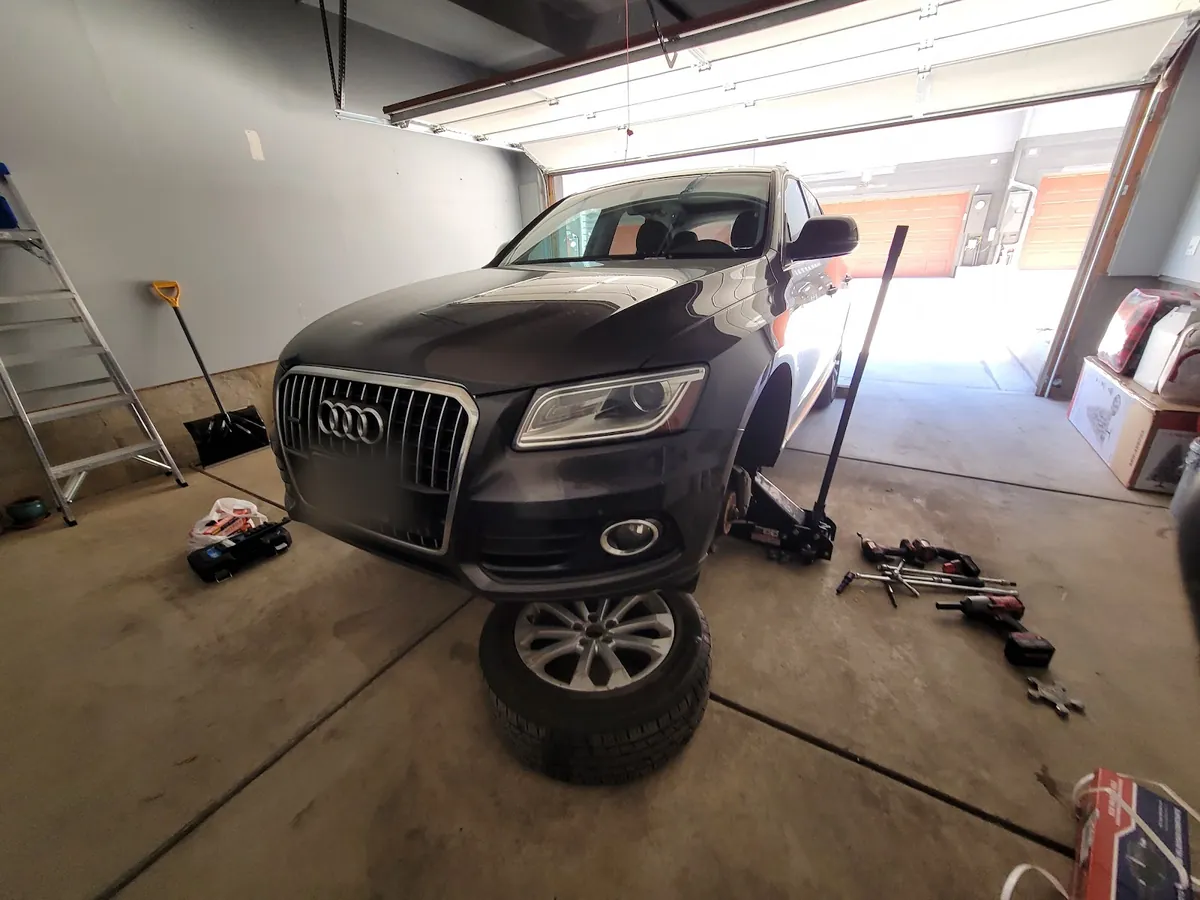
Dark gray SUV on a floor jack in a home garage with the front wheel off and tools laid out on the floor
Wheel off on a floor jack in a customer's garage. No tow, no waiting room.

Step by Step: What Mobile Brake Repair Includes

  1. Talk and test drive (when it's safe). When did the noise start? Front or rear? If it's safe to move the car, a short drive lets us hear and feel it ourselves.
  2. Wheels off, safely supported. The car goes up on a jack and stands, never just a jack, and we pull the wheels on the axle in question.
  3. Inspect before we quote. We look at pad thickness and how evenly the inner and outer pads wore, measure the rotors and check their surface, check the calipers, slide pins, and hoses for leaks, sticking, or damage, and check the brake fluid level and condition.
  4. Explain and quote. You hear what we found, what needs to be replaced now, and what can safely wait. Nothing gets replaced without your OK.
  5. Get the right parts. Once you approve, we pick up the parts for your exact vehicle and come back to finish the job, usually the same visit.
  6. Do the job properly. Old pads and rotors off, hub face cleaned of rust so the new rotor sits flat, caliper brackets and pad contact points cleaned, slide pins cleaned and lubricated, new hardware where needed, and the caliper piston pushed back carefully.
  7. Torque, pump, check. Caliper bolts and lug nuts tightened to the vehicle's spec, the pedal pumped until it's firm, and the fluid level re-checked.
  8. Bed in and verify. A test drive with a series of controlled stops to seat the new pads against the rotors, then a final check that the noise or pulsing is gone.
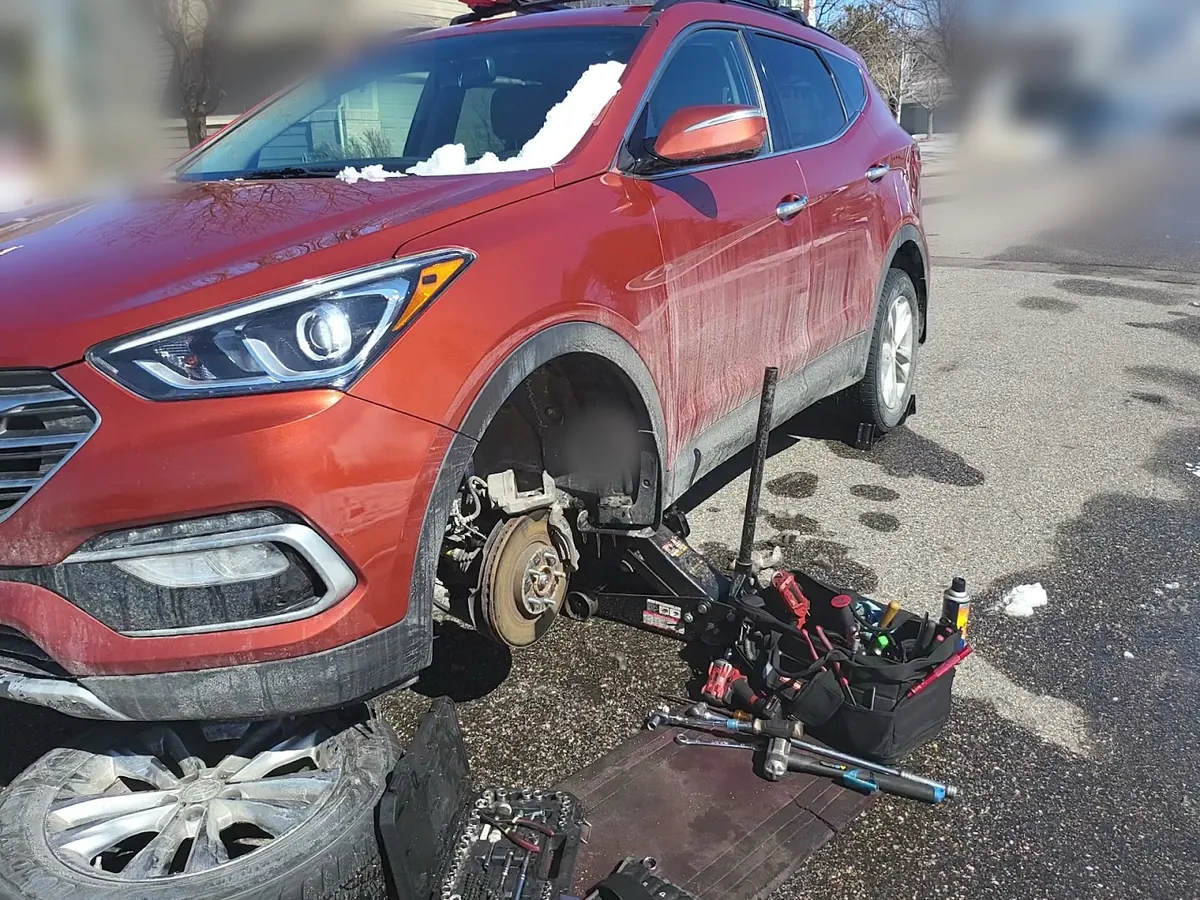
Red SUV supported on a jack curbside on a snowy residential street with the front wheel off, exposing the brake rotor and caliper bracket, tool bag beside it
Curbside on a snowy street: wheel off, rotor and caliper bracket exposed. Brake work doesn't need a shop bay.

Pads Only, or Pads and Rotors?

The honest answer: it depends on what we measure. Every rotor has a minimum thickness set by the manufacturer, usually stamped on the rotor itself. We replace rotors when they're below that spec, when they're deeply scored (common after a grinding pad), cracked, heat-damaged, or causing a pulsing pedal. If they're within spec and in good shape, pads alone can be the right call.
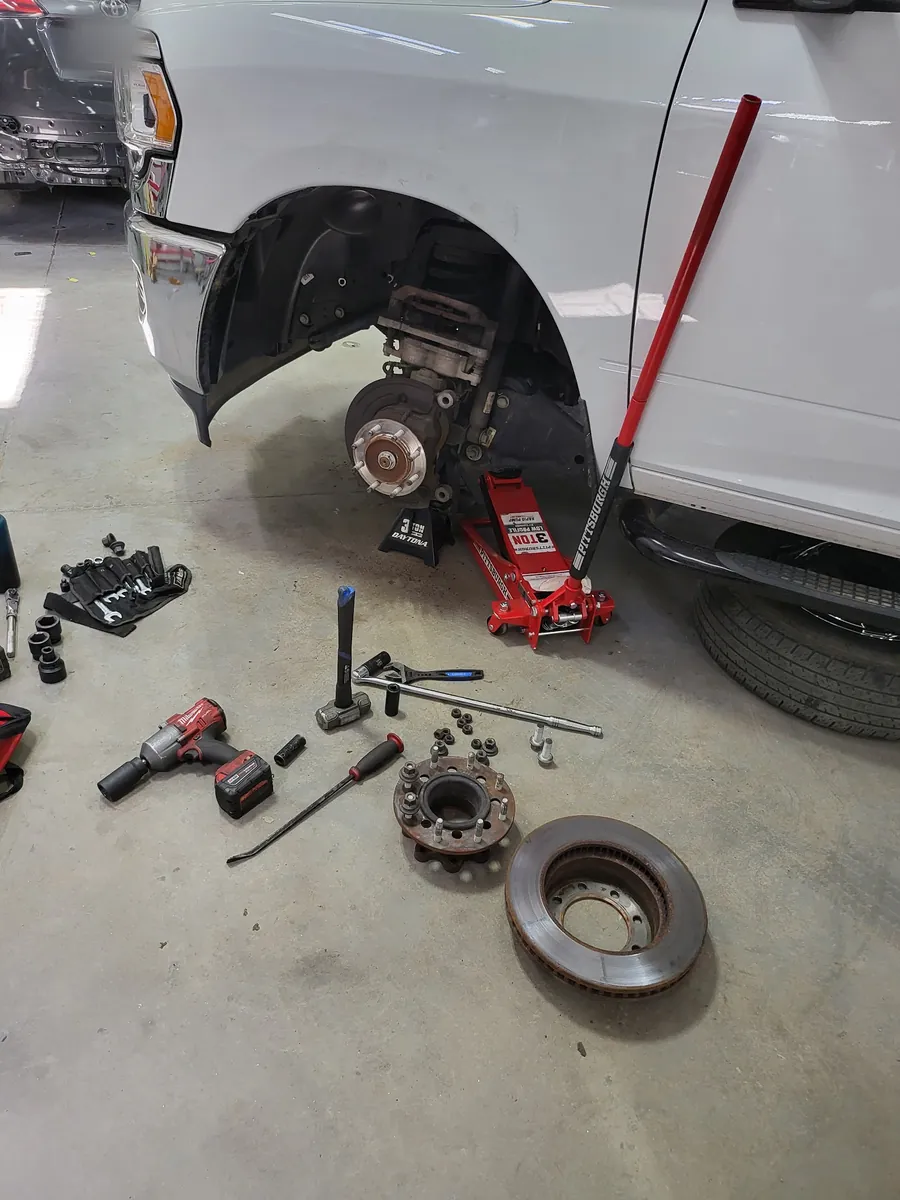
White pickup truck on a floor jack with the front wheel off, the brake rotor and hub assembly removed and lying on the garage floor next to an impact wrench and hand tools
Truck front brakes: rotor and hub assembly off and on the floor.
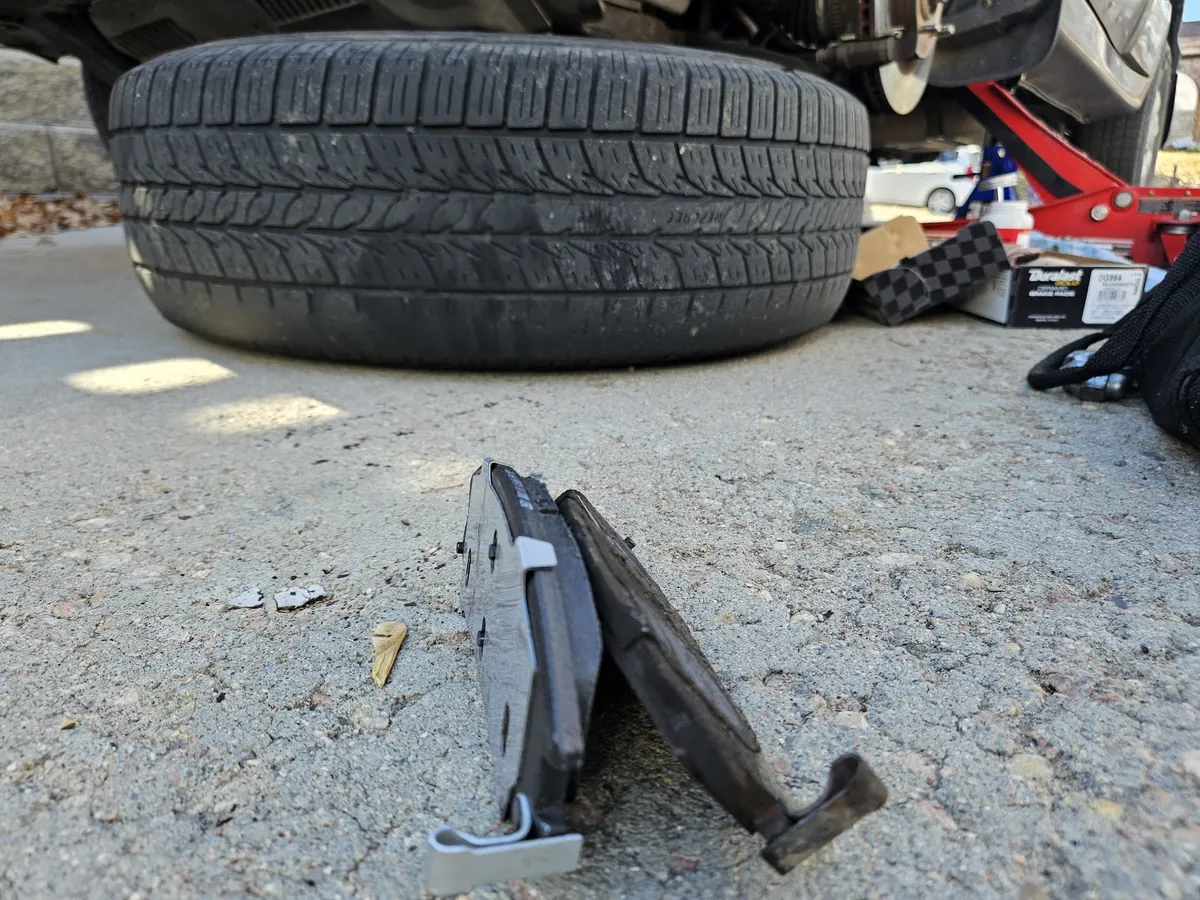
Two brake pads lying on a concrete driveway in front of a removed tire, with a red floor jack under the vehicle behind it
Pads out and on the driveway. How they wore tells us a lot about the calipers.

Why we look at the calipers, not just the pads. If one pad is worn far more than the other, or one side of the car wore faster, a sticking caliper or seized slide pin is often the reason. New pads on a sticking caliper wear out early, so we check before we quote. More on our brake caliper service.

What About Brake Fluid?

Brake fluid absorbs moisture over time, which lowers its boiling point and can lead to a softer pedal on long downhill runs, like coming back from the mountains on I-70. We check it on every brake job and, if it's dark, low, or due, recommend a brake fluid flush, quoted separately.

If the ABS or brake warning light is on, that's a scan, not a guess. Here's what a real scan shows vs. a free code read, and the same test-first approach we use when a car won't start.

What to Tell Us When You Call

  • Year, make, model, and rough mileage.
  • The symptom: squeal, grind, pulsing, pulling, or soft pedal, and whether it's front or rear if you can tell.
  • When the brakes were last done, if you know.
  • Any warning lights on the dash.
  • Where the car is parked: driveway, garage, street, or a work lot.

We'll give you a quote by phone, then confirm it after we inspect. We work across Denver and nearby suburbs including Aurora, Lakewood, Arvada, Westminster, Thornton, and Littleton. See all our mobile brake services.

Frequently Asked Questions

Can mobile brake repair really be done at my home?

Yes. Pad and rotor replacement, caliper work, and brake fluid service can all be done in your driveway, garage, street parking, or work lot. We bring the jacks, stands, and tools. We just need a reasonably flat, safe spot to lift the car.

Is it safe to drive with grinding brakes?

Grinding often means the pad material is worn through and metal is rubbing the rotor. That reduces braking and damages the rotor with every stop. Drive as little as possible and call us. If the pedal feels soft or sinks to the floor, don't drive the car at all.

Do I always need new rotors with new pads?

No. We measure the rotors against the manufacturer's minimum thickness and check them for scoring, cracks, and heat damage. If they're within spec and in good shape, pads alone can be the right repair, and we'll tell you.

Can I buy my own brake parts?

Yes. Our labor rate is $125 per hour when we supply the parts and $165 per hour when you supply them. Let us know when you call so we can confirm the parts fit your vehicle.

How much does a brake job cost?

It depends on the vehicle and what the brakes need, so we quote by phone. Call 720-507-7918 with the year, make, and model and what you're hearing or feeling, and we'll give you a quote, then confirm it after we inspect the brakes.

Need Brake Service in Denver? We Come to You

Tell us what you're hearing and where the car is parked. We'll inspect the brakes on-site, show you what we find, and once you approve, get the parts and finish the job.

Call 720-507-7918
Call Now · 720-507-7918